


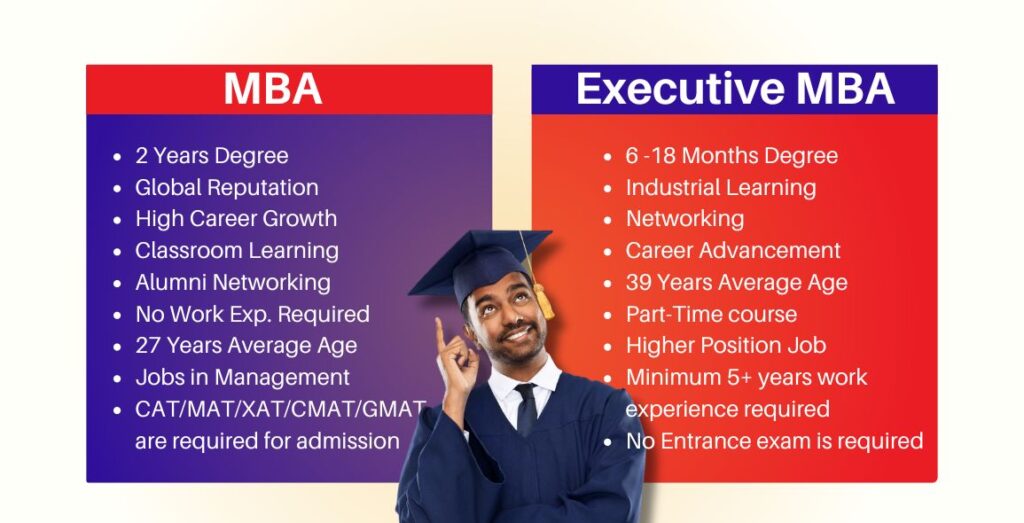
Most people are confused about selecting between regular MBA courses of executive MBA courses. Especially candidates with work experience face the juggling of thoughts as they want to do a master’s but don’t want to leave their job. Both courses are best, but what a candidate needs depends on the requirements of that person from the course. Despite the difference between full-time and part-time courses, the main difference lies in the course, curriculum, motive of the course, and the outcome. Both the courses guarantee industry-related skills, and networking opportunities, but do not guarantee job security. Since both degrees have their benefits, let's find which is best for you between the MBA vs Executive MBA.
10 Difference Between an MBA vs Executive MBA?
| Particular | MBA | Executive MBA |
| Duration | 2 Years | 6 Months – 18 Months |
| Cost | 2.00 Lakh to 10.00 Lakh | 50000 – 4,00,000 Lakh |
| Worth | Higher Return | Higher Return |
| Placement | 5.00 LPA | 10.00 LPA |
| Networking Opportunities | Alumni, Professor and Batchmates | Industry people and managers |
| Learning Environment | Classroom, case study, internship, projects | Experimental learning, Industry learning |
| Course Focus | Get Management jobs | For the career advancement |
| Work Experience | Not Required | Minimum 3 Years |
| Peers | Students of Graduations | Industry working people |
| Motive of Course | To make a student job-ready | To make a person a higher post in the career |
MBA (Master of Business Administration)
MBA or Master of Business Administration is a traditional master’s degree with a duration of a minimum of 2 years. It’s a full-time classroom course in which students learn about management. An MBA is mostly about theoretical management learning. For admission to an MBA course, an applicant in India needs to appear in the CAT/MAT/XAT/CMAT/GMAT examination. Well, it doesn’t require one to have working experience to pursue an MBA, but admission chances it's good to have
- There are 5500+ management institutes in India, of which 3800+ are private, 530+ are government, and 1100+ are public-private.
- 49.50 Lakh is the fee for an MBA at the Indian School of Business, Hyderabad, which is the highest in India.
- Dayalbagh Institute in Agra has a fee of 10K, which is the lowest in India.
- CAT/MAT/XAT/CMAT are the most popular entrance exams for an MBA.
- 1.75 crore is the highest package for an MBA in 2024 by IIM Ahmedabad.
Read about – MBA vs PGDM | Best MBA specialization for engineers
Top MBA Colleges in India
| Rank | College Name | Location | Score |
| 1 | Indian Institute of Management, Ahmedabad | Ahmedabad, Gujarat | 937.24 |
| 2 | Faculty of Management Studies, University of Delhi, Delhi | Delhi, India | 933.39 |
| 3 | Indian Institute of Management Calcutta, Kolkata | Kolkata, West Bengal | 931.2 |
| 4 | Indian Institute of Management Bangalore, Bengaluru | Bengaluru, Kerala | 925.89 |
| 5 | Indian Institute of Management, Kozhikode | Kozhikode, Kerala | 921.88 |
| 6 | Indian Institute of Management, Lucknow | Lucknow, Uttar Pradesh | 915.04 |
| 7 | Indian Institute of Foreign Trade, New Delhi | Delhi, India | 909.7 |
| 8 | Indian Institute of Management, Mumbai (Formerly, NITIE, Mumbai) | Mumbai, Maharashtra | 903.86 |
| 9 | Indian Institute of Management, Indore | Indore, Madhya Pradesh | 900.35 |
| 10 | Shailesh J Mehta School of Management, Indian Institute of Technology Bombay, Mumbai | Mumbai, Maharashtra | 895.33 |
| 11 | Indian Institute of Management, Raipur | Raipur, Chhattisgarh | 889.79 |
| 12 | Vinod Gupta School of Management, Indian Institute of Technology, Kharagpur | Kharagpur, West Bengal | 884.92 |
| 13 | Dept. of Management Studies, Indian Institute of Technology Delhi, New Delhi | Delhi, India | 879.45 |
| 14 | Indian Institute of Management, Udaipur | Udaipur, Rajasthan | 875.2 |
| 15 | Indian Institute of Management, Ranchi | Ranchi, Jharkhand | 866.18 |
| 16 | Department of Management Studies, Indian Institute of Technology Madras, Chennai | Chennai, Tamil Nadu | 861.4 |
| 17 | MHRM Department of Humanities and Social Science, Indian Institute of Technology, Kharagpur | Kharagpur, Haryana | 857.59 |
| 18 | Jamnalal Bajaj Institute of Management Studies, Mumbai | Mumbai, Maharashtra | 852.84 |
| 19 | University Business School, Panjab University, Chandigarh | Chandigarh, Panjab | 848 |
| 20 | Taxila Business School | Jaipur, Rajasthan | 814.72 |
Also check – Top 20 MBA colleges in India | Tier 1 MBA Colleges in India
Pros and Cons of an MBA
| Pros (Advantages of an MBA) | Cons (Disadvantages of an MBA) |
| Career Progression | High Cost |
|
|
| Salary Growth | Opportunity Cost |
|
|
| Professional Network | Saturation Risk |
|
|
| Knowledge and Skills | Pressure and Stress |
|
|
EMBA (Executive MBA)
Executive MBA is not a regular degree; it’s crafted for working professionals. It is mandatory to have a minimum of 5 years of working experience for the EMBA. As per the data, the average age of EMBA students is 39 years. It focuses on the industry-relevant skills for career advancement. Due to its shorter duration, the course covers all the things at a fast pace. Since all the students are working professionals so all the lectures in EMBA are typically held on the weekends
- There are 450+ executive MBA colleges in India.
- Indian Institute of Bengaluru is the best college for EMBA in India. It has ranked 41st in the QS Global ranking for EMBA.
- The average salary after the EMBA in India is around 10.00 LPA if the candidate has more than 4 years of working experience.
- No Entrance exam is required for admission candidates to crack the admission interview.
Top Colleges for Executive MBA in India
| Name | Courses | Work Experience | Fees | Placements |
| IIM Ahmedabad | Post Graduate Program for Executives | Minimum 4 years (full-time) | Rs. 22 lakh | Rs. 35.68 LPA |
| Indian School of Business | Post Graduate Programme in Management for Working Professionals | 5-12 years (full-time) | Rs. 28 lakh to Rs. 35 lakh | Rs 34.20 LPA |
| IIM Bangalore | Executive Post Graduate Programme in Management | 4-12 years | Rs. 29.52 lakh | Rs. 35.31 LPA |
| Taxila Business School | Executive Post Graduation Diploma in Management | 2 Years | Rs. 1.15 Lakh | Rs 28.60 LPA |
| IIM Calcutta | Post Graduate Programme for Executives | Minimum 5 years | Rs. 22 lakh | Rs 35.07 LPA |
| XLRI(Xavier School of Management) | Post Graduate Diploma in Management (GM) | Minimum 5 years | Rs. 17.5 lakh | Rs 28.90 LPA |
| IIM Lucknow | Working Manager’s ProgrammeInternational Programme in Management for Executives | Minimum 3 years | Rs. 12 lakh | Rs. 32.23 LPA |
| IIM Indore | Executive Post Graduate Management Program | Minimum 5 years | Rs. 18 lakh | Rs. 30.21 LPA |
| SP Jain Institute of Management | Post Graduate Executive Management Programme | Minimum 5 years | Rs. 7.5 lakh | Rs 33.00 LPA |
| Great Lakes Institute of Management – Chennai | Post Graduate Executive Program in Management | Minimum 8 years | Rs. 8 lakh | Rs 15.10 LPA |
| MDI Gurgaon | Executive Post Graduate Programmes | Minimum 5 years | Rs. 9.3 lakh to Rs. 13.7 lakh | Rs 26.00 LPA |
| IMT Ghaziabad | Post Graduate Diploma in Management (Executive) | Minimum 5 years | Rs. 12.50 lakh | Rs 17.45 LPA |
| International Management Institute (IMI) | Executive Post Graduate Diploma in Management | Minimum 5 years | Rs. 11 lakh | Rs 17.01 LPA |
| XIMB | Executive MBA | Minimum 3 years | Rs. 15.4 lakh | Rs 20.03 LPA |
| K J Somaiya Institute of Management Studies and Research | Post Graduate Diploma in Management (Executive) | Minimum 5 years | Rs. 5.6 lakh | Rs 14.07 LPA |
| IIM Udaipur | Post Graduate Diploma in Business Management for Executives | Minimum 2.5 years | Rs.13 lakh | Rs 20.09 LPA |
| IIM Raipur | Post Graduate Programme in Management for Working Executive | Minimum 5 years | Rs. 6.4 lakh | Rs 21.04 LPA |
| Lal Bahadur Shastri Institute of Management, Delhi | PGDM Executive | Minimum 5 years | Rs. 19.5 lakh | Rs 12.24 LPA |
| Symbiosis Institute of Business Management, Pune | MBA Executive | Minimum 3 years | Rs. 5 lakh | Rs 26.50 LPA |
| IIM Kozhikode | Executive Post Graduate Programme | Minimum 3 years | Rs. 8 lakh | Rs 31.02 LPA |
| IIM Rohtak | Executive Post Graduate Programme | Minimum 3 years | Rs. 6.2 lakh | Rs 18.73 LPA |
| IIT Bombay, SJMSOM | Executive MBA | Minimum 7 years | Rs. 36 lakh | Rs 28.88 LPA |
| FMS, Delhi | MBA Executive Programme | Minimum 5 years | Rs. 50,000 | Rs 34.01 LPA |
| IIM Kashipur | Executive Post Graduate Programme in Management | Minimum 2 years | Rs. 8.05 lakh | Rs 18.10 LPA |
| IIFT, Delhi | Executive Post Graduate Diploma | Minimum 3 years | Rs. 3.5 lakh | Rs 29.01 LPA |
| IIM Shillong | Executive MBA | Minimum 5 Years | Rs. 22.71 Lakhs | Rs 18.76 LPA |
| Department of Management Studies IIT, New Delhi | Executive MBA | Minimum 3 Years | Rs 18 Lakhs | Rs 24.45 LPA |
| VGSOM – Vinod Gupta School of Management IIT, Kharagpur | Executive MBA | Minimum 3 Years | Rs 6 Lakhs | Rs 22.13 LPA |
| IIM Madras | Ex MBA program | Minimum 3-5 Years | Rs 17 Lakhs | Rs 20.19 LPA |
checkout – Top MBA Colleges for Executive MBA in India
Pros and Cons of an Executive MBA
| Pros (Advantages of an EMBA) | Cons (Disadvantages of an EMBA) |
| Maintain Income | Dual Commitment Stress |
|
|
| Immediate Application | Higher Total Cost |
|
|
| Peer Learning | Program Intensity |
|
|
| Career Advancement | Limited Placement Access |
|
|
Which is more worth an Executive MBA or an MBA?
Well, answers to this question vary from person to person. For experienced candidates with a good job profile executive MBA has good worth due to its short duration and lower fees. In general, MBA graduates from the top 100 MBA colleges in India have more than 10.00 LPA on average. The traditional MBA degree has a global reputation and is recognised by all the companies and institutes around the world.
Which one is best for you, MBA and EMBA?
- If candidates have no working experience, then an MBA is the only option they have. Without prior working experience, no one can pursue the executive MBA course.
- Candidates having more than 5+ working experience should go for the EMBA instead of a regular MBA. The reason is that classes will be on the weekends, so they do not need to leave their jobs, and the duration of the course is also short.
- If someone is in the early stages of their career, they should go for the CAT or other competitive exams and try to be admitted to top MBA colleges of India, such as IIMs, FMS, IITs, and more.
- Candidates who have less time can opt for the EMBA as the duration of the course varies from 6-18 months depending on the institute.
- The main motive of the course is to advance in my career. EMBA is the better option, and if I want to go on a managerial post, then an MBA is the right option.
Conclusion
You should take your program selection decision based on your current professional standing. The decision becomes simple when you assess your work history and future goals. If you have little or no work experience, you should enroll in the full-time MBA. This two-year program builds foundational management knowledge. You gain essential skills and access to campus placements to launch your career. If you possess three to five years or more of relevant experience, the Executive MBA (EMBA) offers better value. You continue earning your salary, eliminating lost income. You learn from senior peers and apply coursework directly to your job. The EMBA validates your existing experience for a higher position.